January 2012

January 27, 2012

I have had adventures! At the start of the month I went to North Vietnam. For the first 10 days I went on a textile tour to the minority groups north west of Hanoi organised by Serena Harrigan (Textile Odyssey: www.textileodyssey.com) It was a small group of 6 including Serena with the services of a driver and interpreter. Following the tour, my USA friend, Deb McClintock, who had also been on the tour and I organised a trip west of Hanoi through the same services of Discovery Indochina (www.discoveryindochina.com) that Serena had used. We had the same interpreter that we’d had on the previous trip and I can’t speak highly enough of his enthusiasm, knowledge and willingness. If ever I was going back to Vietnam I would certainly use this company.

Rather than give a diary of what we did, I will report on the textiles, focusing on looms and what was woven for which group.

Loom of Pathen minority group, Tan Trinh village. We visited a school where a group of weavers were currently weaving a head scarf. It was exciting to see a school where weaving tradition was being taught. Initially I wondered at the fact that everyone was weaving exactly the same sequence. It was interesting to note that as the trip progressed, it was clearly evident that it was the norm for people to have what was in essence a “uniform”. The “unifiorm” may have minor variations but an initial impression was that everyone was dressed the same.

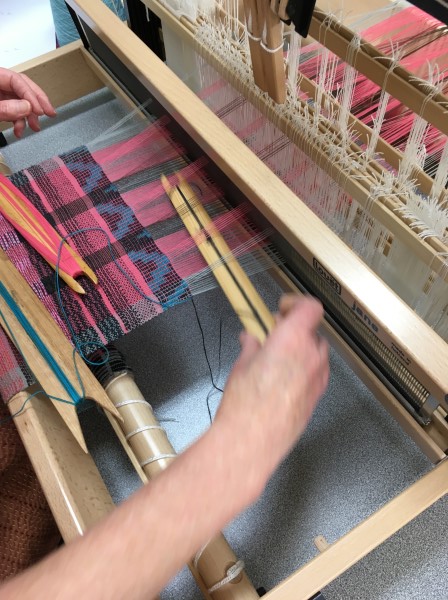
Back strap loom on frame. The warp passes over a bamboo pipe to provide one shed. The alternative threads are on string heddles supported on a bamboo stick. The bamboo pipe is also used for storage. This loom has an interesting mechanism for lifting the alternate heddle shed. The shaft is tied to an arm that is part of a structure mounted at the back of the loom that pivots. This is then tied to the weaver’s foot. To lift the shed, the weaver moves her foot back. This structure is not always present. If the weaver is doing plain weave then it is used. If she is doing a section of brocade it isn’t mounted. The loom can be picked up and moved easily. We did not see any method of storing the supplementary weft pattern. Each row was individually picked up.

Fabric woven: plain weave with supplementary weft both continuous and brocade. This was a very useful tool used for both supplementary techniques. The fine warp and weft looked like polyester overlocking thread (either black or white was being used) with the heavier thread being acrylic. The weavers refer to a pre- existing fabric to follow the pattern. Note the use of a temple which is suspended under the fabric out of the way of the brocading.

Variations of the scarf fabric are also pieced into the costume. In all the examples I measured, the weaving width was 19 cm. The scarf (not put on) is folded so that the outside edges are inside to a width of 6 cm. The edges are tacked together. The length of the scarf is 250 cm with brightly striped sections including supplementary weft pattern and brocade (similar to what was being woven) of 68 cm at both ends and a centre section of pick up supplementary weft in one colour.

Black Hmong. At this village we had a demonstration of the entire process from spinning to dyeing the batik hand woven fabric. Here is an overview.

This was an interesting breaking system and we saw other variations of this on most looms. The back beam has spokes. A bar slides forwards to allow the beam to move and then is pushed back to stop. The weaver has a slot on the front beam into which a peg is inserted to keep the warp tight. Only plain weave was being woven so two shafts only are required.

Batik may be done. Bees wax is used.

Fabric is dyed in indigo. Leave in indigo for 1 or 3 minutes to start, remove allow to nearly dry 3 times per day. Then extended to 2 hours dip per day for 3 months. The fabric is extremely dark. The batik’s dye process is ‘only’ for 1 month and is for approximately a total of 120 dips.

Calendering the fabric produces shiny metallic cloth. Bee’s wax is applied to both the cloth and the underside of the rock. The dyer stands on the rock and works the rock over the fabric exposed on the pole polishing the surface.

The batik fabric produced is pieced into garments and may be combined with embroidery. The calendered fabric is used for sections of the jacket and apron. We were told that after 3 washes it reverts to the unpolished state. Some of the previous images show examples of garments and textiles with both batik and calendered cloth.

The loom of the Tay  found in Ban Ho village and in the foyer of the Sapa Hotel.

 This loom is similar loom to that in the Black Hmong. Stripes and checks in acrylic yarns were commonly being woven.

These scarves were for the tourist market and were being woven on the loom in the hotel foyer. Note the spokes on the warp storage beam and the bar that is moved to advance the warp.

Once the warp has been loosened, the cloth beam is advanced. The peg is inserted into the beam and fine tuning of tension achieved by winding the cord around the peg; a very simple and effective mechanism.

Winding spools of yarn for both weaving and warping from a skein. Variations were seen from the primitive to this more refined version. Note the bamboo bobbins.

Winding a warp. Bobbins were placed on this rack and walked around the posts under the house to obtain the appropriate warp length.

This weaver had a number of cloths for sale. They were also sold to other groups as well as within their ethnic minority. The cloths that were potentially woven on this loom were all plain weave. They included head scarves (usually in acrylic).  I bought some plain weave cotton and hemp yardage. The cotton was quite stiff. The weaver showed me the singles cotton yarn that she was using. It was quite softly spun. She had sized it with rice water. “After cleaning rice, pour off the water”. This water was then boiled to reduce. It was the washing water that was used and not the water that the rice was cooked in. The cotton was then sized in this bath.

The loom of the Lao (others may call them Lu) of the Na Tam village. The looms here were used to weave patterned fabric with quite complicated supplementary weft patterning including some brocade. The frame is quite rough in construction. This one was made by the husband.

The warp passes over the top of the loom and is knotted above the weaver’s head. To advance the warp, the knot is loosened and then reknotted. The ground is 2 shafts . Note the series of bamboo sticks that record the weaving pattern.

The fine black thread used for both warp and weft looks like a polyester overlocking thread. The weft brocade is “silk”. Note that each colour has a separate thread for the inlay.  The weaver picks up the pattern, weaves the row then transfers that pick up to a stick at the back of the loom. The greater the number of pattern rows, the greater the number of sticks that are transferred to the back of the loom. This stored information is then used to weave the mirror image thus resulting in the weaver having to do only 1 pickup sequence for a mirrored repeat. The stored information can only be used once. To complete another sequence, the weave has to repeat the process.

Skirt showing combination of brocaded fabric combined with ribbons of both commercial and handwoven fabric.

We saw this striped and brocaded patterned fabric being woven that was later cut up for the ribbons used as decorative trims in the skirts and jackets. The blankets were woven with cotton/polyester background and an acrylic supplementary weft.

Both of the following looms were being used in the same area. The Thai were weaving brocade/supplementary weft fabrics while the Hmong were weaving warp manipulation and supplementary warp. These were seen on Deb’s and my trip to the Hoa Binh Province west of Hanoi.

Thai loom

Warp wound and string heddles threaded.

Once the warp is on the loom, bundles of warps (in this case 4 ends) are grouped onto the vertical structure. These bundles will be manipulated to achieve a method of remembering the pattern to be repeated during weaving.

The design is first picked up. (multiples of 4)

Once it has been picked up the pattern is transferred onto the vertical storage device at the front. To weave the pattern from the front of the storage device is transferred to the warp behind the heddles and at the same time moved to the back. In this way there will never be a need to re pick up the design as was the case with the Lao loom.

I was very taken with this tool to hold the shuttles. Without this it would be very difficult to stop the weft yarns tangling. Bobbins for brocade were often wound on bamboo. They may be stored in a length of bamboo cut in half lengthwise.

These scarves were being woven for the tourist market. We were however very fortunate to be shown traditional textiles from this weaver’s collection. The grandmother is now 66 and she started weaving at 12. We saw 2 daughters who were extremely skilled weavers.

This traditional cloth incorporates symbolism representing monkey, flower and fruit. It requires 72 bamboos or pattern rows in half a mirror repeat. Indigo dyed, homespun cotton.

Horse and saddle motif in silk brocade. Each pattern row has several bobbins of colour. There are 140 bamboos or pattern rows in half a mirror repeat.

Loom of the Hmong used to weave warp manipulation fabrics. The beater that was used on this loom was combined with a shuttle. Rather than being flat underneath it had a pointed edge, thereby allowing the weft to be beaten in at the same time that the weft was inserted. It certainly saved time by the total process not requiring 2 pieces of equipment.

In combination with a plain weave row which is lifted by the shafts using a counterbalance action, each row requires a lift of a pattern shaft. The only pattern that I saw being woven in this technique was of a dragon. In fact this loom was referred to as a dragon loom. The technique requires the manipulation of the warp resulting in bringing warp threads into the opposing shed. The fabric is warp faced and utilises colour sequencing.

These two fabrics were combined in the top of the Hmong costume. One is the dragon fabric the other is a supplementary warp fabric. There are long floats on the reverse of this fabric. The colour is in the supplementary warp on a black, plain weave, warp faced  fabric. They could both be woven on this loom.

While I have focused on the looms and the fabrics that were woven on this trip we saw a number of ethnic minority groups each with their distinctive dress. Embroidery, indigo dyeing, batik, weaving and methods of construction, combination of elements, colour and style made each group distinctive. Groups that were seen include Hmong ( Flower, Black, Blue) Pathen, Dao (White, Red), Tay, Giay, Lao, Thai, Viet Kinh. It was a very culturally rich experience. Other places of interest were the Museum of Ethnology, and the Women’s Museum, Hanoi and the Museum of Cultures, Thai Nguyen

I have however 2 regrets. The first is that I didn’t get that silk yarn when I saw it. The other is that due to the weather (rain, fog, mist and possibly even smog) we saw very little scenery. We did have 30 minutes of fine weather when we were above the cloud.

Looking across to Fan Si Than, the highest mountain in Vietnam


November 2011

December 27, 2011

I hope that everyone is in the midst of a very enjoyable festive season.

From India last month I look to New Mexico for a source of design.  For those who have been following my blog you have probably realised that I’ve been looking at past adventures /research destinations as a monthly source of inspiration.

2010 was the destination for Convergence and Complex Weavers Seminars. While there I had adventures with a group of weaver friends and then had a magnificent road trip with Judie and Dalbert Eatough (Blog August 2010) to their home in Utah.

Where to go to for the design source? Pottery spoke to me. My mother was a potter so I am often drawn to it. I saw some wonderful examples of contemporary pottery in a Santa Fe gallery which also shared the same motif with Pueblo pots in various museums. It is fascinating to think of the same motif being passed down through generations. This motif also appears in other medium including weaving and in other cultures worldwide. It is such a universal motif.

For colour I have used those found in the landscape, a string of turquoise beads that I bought on this trip and a Navajo necklace I acquired on my first visit to USA in 1994.

In addition I have drawn inspiration from a vase that I brought home. The motif of feathers seemed an appropriate link with last month’s design based on peacock tail feathers.

A banksia that I planted as tube stock at least 2 years ago has finally produced its first flower. At a distance it looked black and uninteresting but up close the stamens were dark green with a purple/red core.  Then as a week went by and it opened more fully it became a much lighter green.

Best wishes for a wonderful New Year.


November 2011

December 1, 2011

This month’s focus is on design inspired by my adventures in India in 2008. Our adventures were based in Gujarat and Rajasthan. I have very vivid memories of bright colours that zing and yet also being amazed at the white costumes of daily life and the notion of keeping them white. Memories of textiles in a multitude of techniques: bandani (shibori), ikat, wood block printing, embroidery, mirror work, natural dyeing including indigo, simple and complex weaving patterns. Then there is the echo of over ornamentation that crosses over into decoration on houses and public places. India is rich, diverse visually and an overwhelming feast for the senses.

As a starting point, I decided that I needed to select 2 motifs: a very difficult task. The criteria were that they had to have some significance for me and that the primary source was not textile. I did have a lovely time looking back through images and remembering. These motifs would then be converted into woven designs. My intention is not to reproduce Indian textiles but rather use them as inspiration.

 I spent a lovely day with a friend who was living there and with some of his Indian friends. I visited their home and saw marble screens with decorative carving to let in the light and keep out the heat. We saw a number of exquisite and very diversely patterned screens in various castles where they were used to separate the women’s quarters so that the women could look out but no man look in.  A whole subculture existed there. The concept of looking through and community appealed. I have chosen a screen pattern and squared it to suit my purposes.

A common image used in various forms relates to the peacock. This sacred bird was declared the national bird of India in 1963. It has a very long history of design motif usage both in architecture and textiles. The shape of its tail is used extensively to frame windows and entrances.  I came across this glorious example in a wonderful palace courtyard in Udaipur. The fact that feathers are universally used in design was also of influence in selection.

The following are some of the pieces I have woven using both motifs.

In spite of the fact that India does equal colour, I chose to acknowledge the imapct that white had for me. This colourway is also very reminescent of the interior of the mud house.

This silk wrap combines both motif in the design.

But, India does mean colour. Saturated colour has been used in this double weave scarf using the screen motif.

This scarf combines several techniques acknowledging the diversity of Indian textiles.  Variations of the feather motif have been used.


October 2011

November 5, 2011

This month’s focus is on design inspired by my adventures in West Timor. (July 2010Post) I have chosen to use two designs. Both have been
chosen from a design point of view but also because the design has meaning for me.

While the “hook” motif is used in their textiles in various forms including ikat and sotis (manipulation of warp floats), I have also seen it used in carvings. It was the experience however of being greeted at every village by the chief with a welcoming speech stressing the importance of  relationships between us that has left a long lasting impression. Then, when our interpreter explained the dance as being another interpretation of the motif of linked arms the hook motif took on an incredible meaning for me. An added interesting fact about the “hook” motif is that I have come across an identical design on a fragment of a carrying strap from pre-Columbian Peru. (Symmetries of Culture, Dorothy K. Washburn / Donald W. Crowe, University of Washington Press, 1998).

These scarves have used the weave structure of warp float manipulation that is used in West Timor. The hook motif has been used as an all over design.

The other design I have been working with is one that I found on a carved post supporting a communal meeting place. The structure consisted of a roof with many supporting posts each carved in different designs by different families. The interlaced design has echoes in other cultures. It is
however the fact that I found it in a meeting place that gave it impact. “Meeting Place” has been a frequent theme in my work in recent times. I have  been using the concept to illustrate the importance of having common ground for cultures to develop understanding and tolerance.

I chose to use both designs as pure graphics in a series of damask cloths. The colours chosen for the damask reflects on my natural dye
experiences there: navy from indigo, red/brown from morinda (tree).

The linked arms motif in the West Timor traditional structure of sotis, has also been interpreted into  several interpretations as a 24 shaft design and used it as an all over motif. Both the following textiles use the design in different structures. In both cases the scale has been considerably reduced and you have to look to see it.

I have also used ikat as a design element. While the ikat style is totally different to the complex designs of  West Timor, I have used it to reflect on the commonality of technique which is found in many countries around the world.

This is a wonderful time in the garden. I thought that I would share the spectacular show of the weeping paperbark. It lasts for such a short time but it is well worth the wait. The soft pink flowers cascade down and totally cover the tree.


September 2011

October 2, 2011

At Hervey Bay Regional Art Gallery I had an opportunity to see Twelve Degrees of Latitude . This is a Museum and Gallery Services Queensland touring exhibition to celebrate Queensland’s 150 th year and has been touring since 2009. It has been drawn from Regional Galleries and University art collections. I have a small piece in the exhibition so it was great to have the opportunity to see it again. I have also just received an invitation to its showing locally at the Redland Art Gallery, 23 October-27 November. Some of the work will be here with the rest of the exhibition at Redcliffe City Art Gallery. So I will have another opportunity to see the works.

Another exhibition well worth a visit is at GOMA. Threads: Contemporary Textiles and the Social Strucute  is on 1 October- 5 February. “Bringing together a diverse range of contemporary textiles from the Gallery’s Australian, Asian and Pacific Collections, the exhibition celebrates the ways in which contemporary artists explore and extend the textile medium.” Many of the works exhibited traditional techniques. Included in the exhibition is a huge tapa cloth especially commissioned for the exhibition.

I have been practicing some carpentry skills. My draw loom had an annoying habit of pattern shafts tilting and not hanging true. The pattern shafts had been suspended from a central point and it was this that resulted in the tilt. To overcome the tilt, I constructed two structures with 20 screw eyes; enough for each shaft. These were then positioned over both ends of the shafts. Venetian cord was then used to replace the original cords. The modification required a doubled cord to run from the toggles at the front and through the original spacer. The use of a bead stopped the cord pulling through the toggle.  The venetian cords then separated to pass through the appropriate screw eye to the shafts below.

A draw loom, by the way has two sets of shafts: one for the basic structure e.g. satin, the other for the actual pattern. The ground shafts have always operated satisfactorily but the pattern ones were a problem. I am very pleased to announce that my modification works perfectly.

One of the major highlights for this month has been all the associated activities in launching my daughter on her grand adventure. Helen has obtained a year’s exchange teaching in the UK. She starts her adventure with a holiday with a friend. Currently she is in Scotland having a grand time.


At the end of August

September 2, 2011

This month is all about my Canadian adventures. Montreal and the Contemporary School of Textile Design was the focus of the trip. I had decided that I needed to learn more about design and weaving using Jacquard looms. The entire two weeks was spent under the expert tutorage of Louise Bebure´ and her offsider Lheila. The focus was on designing on the computer with no hands on loom experience. Technicians wove sections of our  designs as they were created in a variety of techniques including 1 warp, 1 weft; 1 warp 2 wefts; 2 warps, 2 wefts (double weave), 1 warp 3 wefts, samit(samitium). Students in both week’s classes came from a wide backgrounds: young and not so young, male and female, some with weaving knowledge others with computer skills. Weaving knowledge was not a prerequisite of the course and in many ways was not an advantage. However, knowledge of Photoshop was. It was a very challenging, intensive and rewarding course and I have come away with a collection of samples and files for some projects that will eventually be woven.

One of my samples being woven.

A batch of samples hot off the looms.

My collection of samples from the two weeks.

I was also very fortunate while in Montreal to see an exhibition by the French fashion designer, Jean Paul Gaultier. He has a reputation of being the enfant terrible of fashion. His intention is always to shake up the conventional and the bourgeois. While some of the fashions were controversial, others were quite beautiful.

A view of some of the garments. These are from his virgins or madoonas series.

This garments includes a bodice constructed from film strips

In addition to the visit to Montreal, I wanted to go north of Toronto to Moosonee which is a very remote community at the end of the railway line just south of James Bay. The Moose Factory (not a building as such but rather a community on an island in the river opposite Moosonee) is the second oldest settlement in Canada and was originally the base of the Hudson Bay Fur Trading Company. I was hoping to see some Cree art and crafts. In addition, I had been reading about the Company and the Hudson Bay blankets that were used in trading. I was fascinated by the history of the area and the idea of the impact of its remoteness and harsh environment and wanted  to find out more. I did manage to see some beading but there was not as much as I expected. I found out that beading originated through trading with the Company and was not a part of the Cree history before then. I was also surprised to see how many parallels there were with the Australian aboriginals and the impact of the white settlement. There too is a generation who were brought up in mission schools with similar outcomes to our “stolen generation”.

It was only when you saw a display furs that you realise the extent of the animals that were traded by the Hudson bay Fur Traders. This is not the full extent. Beaver fur (second from right) was popular for top hats. this exhibit was in the Cree Cultural Interpretive Centre.

A completed moccasin with beaded floral design. The beads are threaded then the strand is couched down. I would like to thank Candice of the Moose River B&B for putting me in contact with various people in Moosonee.

The month flew by. Now it’s back to working in the studio.


July 2011

July 22, 2011

I know it’s not quite the end of the month but I thought I’d share images of the exhibition early. I also know that life is about to get busy so I’m writing this post when I’ve got some time. The blog this month is all about the exhibition in Darwin. The staff at the gallery worked hard and have presented the exhibition beautifully. They have been a delight to work with. I do love the use of the very ornamental frame that they just happened to have in the back room. I’ve started the images on the left as you walk into the room. They then follow around the room. They are intended to give an overview of the exhibition: Line, Angle, Curve. All the work have elements of geometric pattern. Many of the work have been shown on earlier blogs.


Once I got home, I spent a few days catching up on some work and recovering at Burrum Heads. I have been going there since I was very young. It has been a family connections since my father was a young lad. Every time I visit, I always make sure I walk to the “dead tree”. My mother has memories of it standing out in the water 60 odd years ago. Each time I visit it is more worn, but it is an amazing to consider that it has stood out in the water exposed to the tides for that length of time and possibly much longer.


June 2011

July 3, 2011

Only less than a week to go and I’ll be in Darwin for the opening of my solo exhibition. Here’s the e-invite. If anyone is in the neighbourhood, it would be great if you could get along for it.


There’s not much to show this month from the studio. I have done a number of scarves and have started spending some considerable time on design. Those designs will appear later but at this stage they are still got a way to go before I share them. Here are examples of two scarf series that I have been working on.

 Three doubleweave scarves

Three scarves: Squares in Squares series

In addition I thought that I’d share some textiles from Sumatra, Indonesia. These were originally collected by a Fran Keech in the 1980′s. She was not a “textile expert” at the time but was absolutely fascinated by textiles and went to Sumatra armed with what she had discovered and with an intent to collect. She passed them to me sometime in the  mid 1990′s. I have always made a committed effort to share these textiles and have felt that I’ve held them “in trust”. This seems an ideal venue to share them.

The first  textile is a Palepai or Ship’s Cloth. This particular type of Palepai is known as sesai balak or big wall. (280 x 56 cm). It originated from the extreme south coast of Sumatra. It was probably woven about the early 1900’s or earlier. These have not been woven since then according to what I have been able to find out. It is woven from hand spun cotton yarn.

Technique: plain weave background with supplementary weft pattern. Each colour is woven in its isolated area. Therefore there may be several colours being woven in one pick.

Purpose: These were used to celebrate important rituals: marriage, birth, circumcision, when a man advanced in rank, death. They were hung behind the principal person, with the palepai of other participants being hung to the left and right according to rank. According to Gittinger  in Splendid Symbols: Textiles and Tradition in Indonesia, Oxford University Press, 1990 (original by The Textile Museum, Washington 1979) The history of ships cloths is obscure and the reason for both their original use and their decline remain conjectural. The skill need to produce them is completely lost….. The factors that are presumed to have caused this include the abolition of slavery in 1859, the decline of the pepper trade, and changing marriage traditions. So many have appeared on Western markets in the past five years that it doubtful any significant number remain in use in Sumatra today.

This is a very old ikat textile that was collected on the South Western side of Sumatra. For producing ikat cloth, the warp is wound, then the area which isn’t to be dyed is bound then dyed. As you can imagine there were many tied areas here to produce this cloth. The pattern is very well aligned. Indigo was used to dye the yarn.

This old narrow scarf was also collected from south west Sumatra. In addition to the ikat it has additional pattern with a supplementary weft design.

This is a remarkable textile. It was originally a skirt. Fran who collected it undid the back seam. The background has coloured checks. The pattern is achieved by the use of metallic wrapped around a core of probably cotton. This is then woven as a supplementary weft aligned with the background of checks. I understand that Fran was told it was a “court” skirt from the mid east coast of Sumatra. She later discovered that it wasn’t the “nobility” who wore it but rather women of lesser standing at “court”.

This textile is a little more recent, though not modern.  I have shown a close up detail of the whole. Along the length there are spaced bands of these ikat stripes. The control in achieving the clarity of the ikat design is great. Note the patterned band at the end. This woven band appears at both ends and finishes off the textile. This seems to be typical of the south west.

This is a ”new” textile. It would have been woven in the mid 1980′s. The ikat and supplementary weft (including brocade) traditions are still  being used with glitz. In some ways though this is an extension of the metallic wrapped cotton core thread that was used in a previous textile. The skill in weaving this is excellent.

These textiles are surely a reflection on the skill of weavers spanning more than a century. It can be guaranteed that in all cases they were using “primitive” looms which were most likely back strap.


At the end of May

June 3, 2011

This month, I’m sharing a series of work for the forthcoming solo exhibition at “Framed” in Darwin in July. One of the works was shown last month on the loom. The series is Take Five.  The theme was developed from take five minutes to doodle, daydream and design. Take five of the elements and put them together and design a whole.  At this stage I put a warp on for double weave, wove the first image and then for the next two subsequent pieces, changed elements within the design simply by swapping the black and white layers. Doubleweave, by the way, is a process whereby two layers of fabric are woven at the same time and allows for very graphic, clean images as each layer can have its own colour.

Take Five I 

Take Five II

Take Five III

I was enjoying this design and then wondered what would happen if colour was introduced. So obviously, I took 5 colours. The aim was to explore the interaction of colour between layers.

Take Five IV

Then of course I realised that it needed five in this series. So for the last, I decided to work in one colour and swap a section of the design exchanging colours from one layer to the other.

Take Five V

While I have many more colour ways that I could explore, this series is finished. I have taken five.

There was great hilarity in my garden. I heard the rainbow lorikeets and went to investigate. There was a gathering: some splashing water, others soaking wet and others dry and obviously waiting in line. At one stage I counted 5 in one bird bath, 3 in another and the smaller one had 2 with more up in the trees above. I just had to stop and be entertained!


April 2011

May 1, 2011

Installation by Dr Pamela Croft, resident artist for Fibres Ballarat.

This month I got out of the studio for a week to teach at Fibres Ballarat. The class was on Building Blocks where we looked at the development of profile drafts and interpreted them into a number of weave structures. Each loom was threaded in the student’s own design in a particular weave structure. Then each student wove their own design on the different looms using different structures. By doing this an amazing variety of designs were obtained. The class went superbly well no doubt in no small way due to the amazing dedication of these very focused weavers who often worked well into the night. At the end of the week they had completed an amazing amount of work. In addition to the work, the camaraderie in the class was wonderful. We did have a great time. The following images shows some of the samples produced.

Fibres Ballarat, organised by Glenys Mann of Fibre Arts Australia (http:/fibrearts.jigsy.com) provides a wonderful week of intensive learning in a number of fibre disciplines with both national and international tutors. A great week was had by all!

I did collect an ethnic textile from a trader while at Ballarat. In this ceremonial shawl from Naga, Burma, the supplementary weft pattern is woven in sections across the width. What is interesting is this: where is the pattern on the back? It is totally woven on the face of the cloth. I am looking forward to interpreting this on my loom at some stage.

Work in the studio continues. This week I’ll share a design from drawing to part woven on the loom. These are going to be a series of small framed works in doubleweave. The drawing takes elements and patterns from other weavings and combines them into this graphic design. I have started with the original pattern and for each subsequent one certain elements have been altered, changing white for instance into black. I am then intending these studies to be used to develop larger work. I have included the drawing and subsequent designs being woven. There are two shown.


The garden flourishes. We have had more rain. I am enjoying some beautiful Banksias. This tree is only small but it has seven of these beautiful large spikes.


Follow

Get every new post delivered to your Inbox.